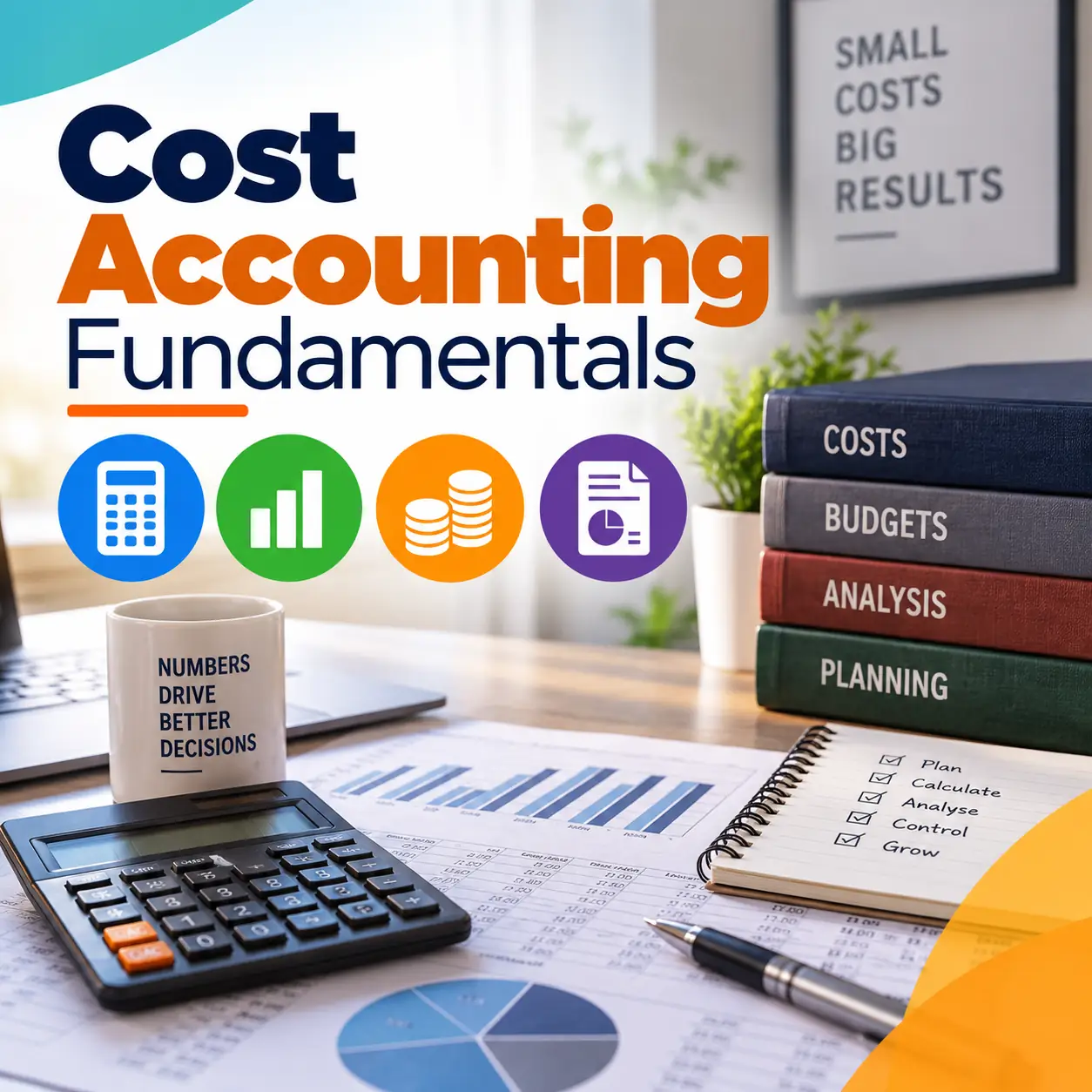
Study a Free Cost Accounting Fundamentals Course with Certificate in South Africa with Durban City Academy. Learn purpose and scope of cost accounting, differences.
10 lessons with topics and quizzes.
The course's hands-on approach uses simple examples and exercises to reinforce learning. You will also discover how cost-volume-profit (CVP) analysis applies to decisions such as pricing or sales strategy. For deeper exploration, supplement your study with related resources on cost drivers or fixed and variable costs available on Durban City Academy's blog site. These free articles expand your understanding with South African context and examples.
Ready to advance your financial skills? Enrol and build your skills with this free cost accounting fundamentals course and earn your certificate online.Cost accounting is essential for controlling expenses and optimising budgets in any organisation. South African businesses—from startups to established firms—rely on this knowledge to stay competitive and profitable. By understanding how costs behave and how to allocate them properly, you gain a practical edge for roles in finance, operations, and management.
Employers value candidates who can interpret cost reports and contribute to budgeting decisions. This course arms you with widely applicable skills to help you participate confidently in workplace financial processes. Whether you seek to enhance your resume or prepare for further studies, these fundamentals form a strong base.
Furthermore, cost accounting knowledge supports better business decision-making, boosting efficiency and sustainability in any economic climate. These skills help you evaluate pricing, identify cost-saving opportunities, and monitor financial performance—critical aspects for South Africa’s evolving industries.
Understand the purpose and scope of cost accounting, and how it differs from financial accounting.
Learn the differences between fixed, variable, direct, indirect, product, and period costs.
Explore how costs behave in response to changes in activity levels and their relevance in decision making.
Discover job, process, and hybrid costing systems used in various industries.
Master principles and methods for assigning overhead costs accurately.
Calculate contribution margins, break-even points, and use these for practical business decisions.
Learn budget types, cost control techniques, and how to apply variance analysis effectively.
Set standard costs for materials, labour, and overheads, and interpret variances to improve performance.
Apply CVP concepts to forecast profits across different sales volumes.
Understand ABC methodology and how it compares with traditional costing.
10 lessons with topics and quizzes covered in this course.
Online courses like this one from Durban City Academy provide flexible access to valuable business skills for South African learners. The digital format lets you study anywhere, anytime, making it easy to develop your cost accounting knowledge without disrupting your daily routine. This is especially helpful for those balancing work and study or overcoming geographic barriers to traditional training.
As South Africa’s economy continues to evolve, employers increasingly seek candidates with up-to-date skills gained through flexible online options. Investing in free cost accounting fundamentals study online supports career readiness and adds to your professional toolkit without financial barriers.
After successfully completing all course lessons and assessments, you will receive a certificate confirming your new cost accounting skills. This free certificate adds value to your CV and can be shared with employers or for further study opportunities. Easy to download, it recognises your commitment to building workplace finance expertise.
Cost Accounting Fundamentals is designed for beginners who want a clear introduction to the subject, with practical lessons, guided learning, and simple explanations that are easy to follow online.
Yes, learners in South Africa can study this course online at their own pace, which makes it useful for flexible learning, personal development, and building practical knowledge from home or work.
This course covers practical learning areas such as Purpose and scope of cost accounting, Differences between financial and cost accounting, Basic cost accounting terms and definitions, Types of costs: fixed, variable, and semi-variable, helping learners build foundational knowledge that can be applied in study, work tasks, and everyday digital learning.
Most learners can work through the course in a few focused hours, but the online format allows you to move at your own pace and revisit lessons whenever you need extra practice.
A certificate is available after successful completion, which gives learners a simple way to show that they finished the course content and assessment requirements online.
These skills are useful because they support workplace readiness, digital confidence, and practical day-to-day tasks, which can help learners strengthen their knowledge in a South African learning and work environment.