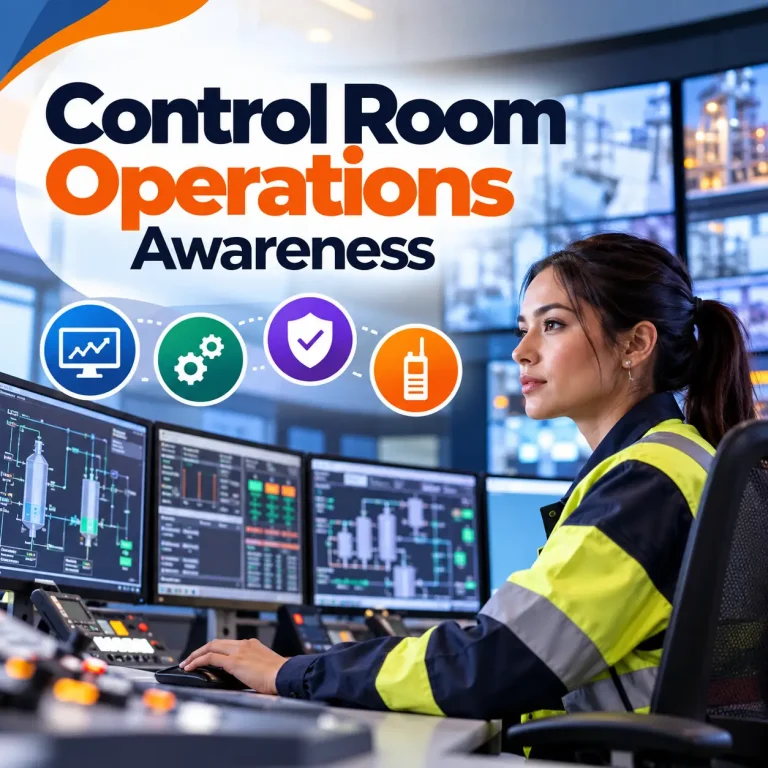
Study a Free Control Room Operations Awareness in South Africa with Durban City Academy. The Free Control Room Operations Awareness Course with Certificate in South Africa is an online beginner course for people who want to understand how control rooms...
The Free Control Room Operations Awareness Course with Certificate in South Africa is an online beginner course for people who want to understand how control rooms support safe, organised workplace operations. Study operator responsibilities, monitoring, communication, incident records and escalation, with a certificate available after completion.
It is suitable for learners preparing for a control room-related role, people who work alongside operational teams, and anyone who wants a practical introduction to control room routines. You will study how to notice changes, share clear updates, keep accurate logs and follow established procedures.
Control rooms bring information and people together so that workplace activity can be monitored and concerns can be passed to the right responders. This beginner course introduces the core ideas without assuming previous control room experience.
In South African workplaces, control room functions may support settings such as manufacturing, utilities, mining and other operational environments. Each workplace has its own systems and procedures, but careful observation, dependable communication and good record keeping are useful across many settings.
Online learning gives you the flexibility to study the basics at your own pace. You can build familiarity with common control room tasks before applying workplace-specific instructions under the guidance of your employer or supervisor.
The lessons also cover practical working conditions. Learn why an organised workstation, comfortable posture and attention-management habits can support alertness during a shift. For more on physical comfort, see these ergonomics ideas for control room operators.
Monitoring is not simply watching screens. Operators need to distinguish expected activity from a possible warning sign, check available information and decide whether a concern should be recorded or escalated. The guide to checking for unusual changes before escalation offers a useful companion to this topic.
Communication and records are equally important. You will practise sharing concise, factual updates, confirming that critical messages have been understood and recording events in a clear sequence. A closed-loop communication approach can help teams confirm important instructions rather than assume they were received.
When several issues compete for attention, operators need to consider urgency, impact and uncertainty while following the correct notification route. You will also learn how a structured handover can make open incidents, pending actions and priorities clear to the incoming shift.
Course learning brings these ideas together through operational scenarios. You will consider how monitoring, communication and record keeping work as a connected process, then reflect on how actions could be improved. When you finish, you can explore the certificate process and further learning options on EduCourse.
Control room awareness can help you understand how routine information becomes an operational update, and how an update can prompt a response. These are useful foundations for people exploring workplace operations or preparing to communicate with teams who monitor equipment, sites or processes.
The course focuses on responsible awareness rather than making decisions beyond an operator’s authority. You will consider when to check information, when to record it and when to use an established escalation route. This practical perspective is valuable in any environment where timely, accurate information matters.
Practical recap: Notice what has changed, verify what you can, record the facts and follow the relevant procedure. If a situation is unclear, use the appropriate escalation route rather than guessing.Explore why organisations use control rooms, what operators may be responsible for and where their authority has limits. Professional conduct and accountability are part of dependable operations.
Learn about workstation organisation, posture, lighting, noise and keeping access routes clear. You will also consider how a comfortable, orderly workspace supports focused work.
Practise maintaining attention across information sources and distinguishing routine activity from unusual changes. The lessons emphasise checking information before acting on it.
Learn to use concise, factual language, choose a suitable channel and communicate with the right level of urgency. Confirming that a message has been received and understood is also covered.
Explore how to record events in sequence, capture key details without speculation and handle sensitive operational information carefully.
Consider urgency, possible impact and uncertainty when deciding what needs attention. Learn to follow notification protocols and keep track of actions while awaiting a response.
Review the value of staying composed, following established procedures and sharing timely updates with relevant responders. The focus is on supporting coordination within the operator’s role.
Learn to prepare a structured handover that identifies open issues, current priorities and pending actions. Confirming who owns the next step helps maintain continuity.
Explore how stress and fatigue can affect judgement, and how approved breaks and attention-management practices can help. Respectful, dependable teamwork is part of the discussion.
Bring monitoring, communication and record keeping together in a scenario that changes from routine to urgent. Review the actions taken and consider possible improvements.
Control Room Operations Awareness is designed for beginners who want a clear introduction to the subject, with practical lessons, guided learning, and simple explanations that are easy to follow online.
Yes, learners in South Africa can study this course online at their own pace, which makes it useful for flexible learning, personal development, and building practical knowledge from home or work.
This course covers practical learning areas such as Purpose of a control room in workplace operations, Operator duties, authority and limits, Professional conduct, alertness and accountability, Ergonomic workstation setup and posture, helping learners build foundational knowledge that can be applied in study, work tasks, and everyday digital learning.
Most learners can work through the course in a few focused hours, but the online format allows you to move at your own pace and revisit lessons whenever you need extra practice.
A certificate is available after successful completion, which gives learners a simple way to show that they finished the course content and assessment requirements online.
These skills are useful because they support workplace readiness, digital confidence, and practical day-to-day tasks, which can help learners strengthen their knowledge in a South African learning and work environment.